
The Coming Leadership Challenge
Mar 30, 2026
Imagine you are the runner of the third leg of an elite 4x400 relay team. The race starts and your starter gets you an early lead and makes a flawless exchange to the second leg who widens your team’s lead before handing you the baton in stride. As you are off to your fastest 100 meter time, you come to the bend and look up to see no one in the exchange zone ahead of you. In fact, your anchor runner is still in the stands watching the race. As you slow down and glide through the exchange zone to earn a disqualification you are asking the question, “what the **** happened?”
For business leaders not tuned in to the generational shift going on in the US work force, they will soon be asking the same question unless they dial into the opportunity to connect with and develop the Gen Z leadership pool that is there for the taking.
For context check out the chart below that shows the last 4 generations of workers:
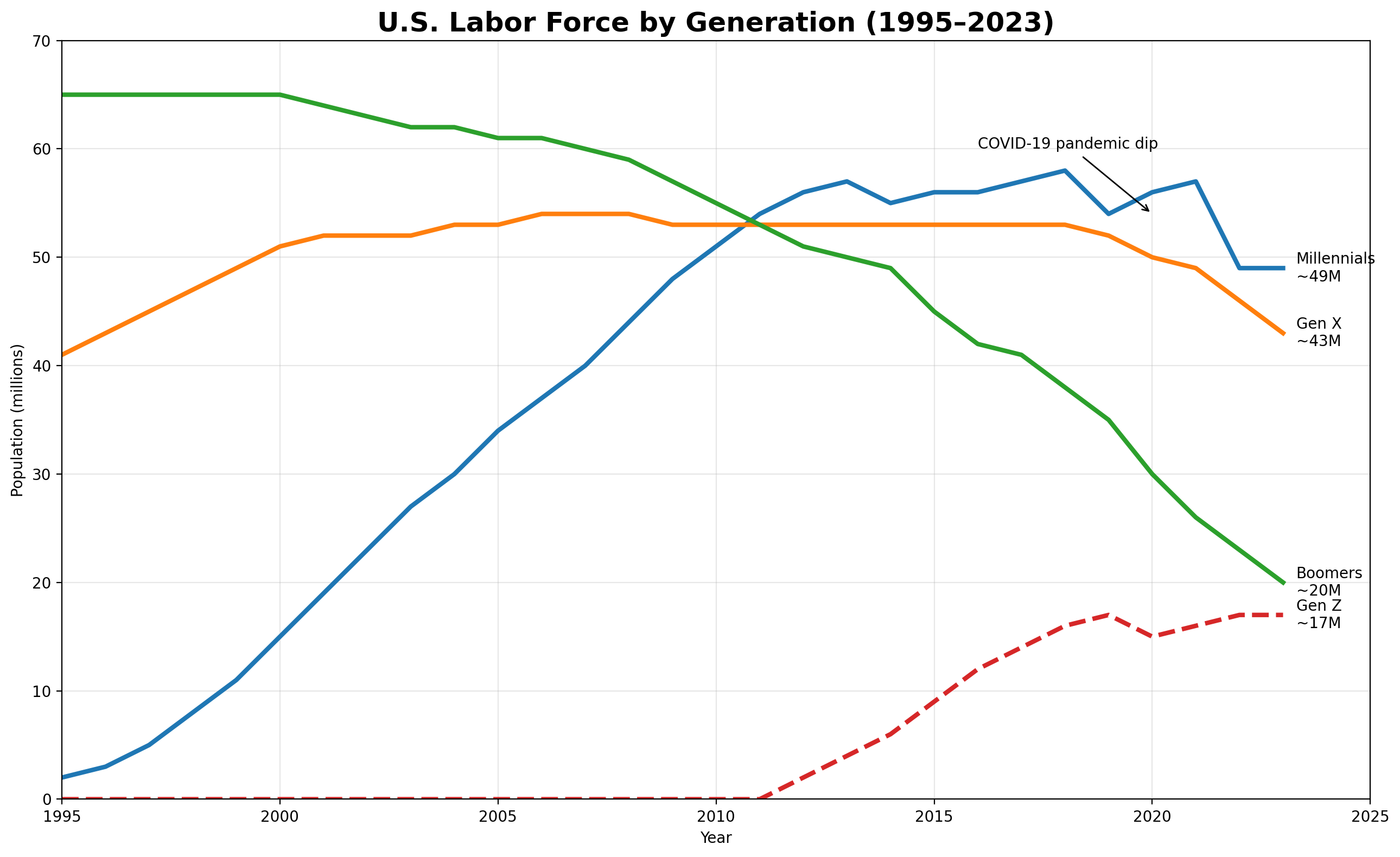
While Boomers, Gen Xers, and Millennials are on the decline, Generation Z is on a fast and steady rise. Generation Z refers to individuals born between 1997 and 2012, ranging in age from approximately 14 to 29 as of 2025. Shortly after this chart’s timeline, Gen Z surpassed Baby Boomers in full-time employment, representing roughly 30 million U.S. workers. By 2030, they will comprise 30% of the total workforce (BLS projections); by 2035, the majority.
High Tech-Low Touch
Gen Z is more connected online than any previous generation. They are the first true digital natives — the first generation to have grown up with smartphones, social media, and on-demand information as unremarkable facts of daily life. However, that connectivity has a paradoxical effect on workplace interpersonal skills. A Deloitte study of 4,000 Gen Z participants found that 37% are concerned that technology is weakening their ability to maintain strong interpersonal relationships. The communication habits formed through texting, direct messages, and social media — brevity, informality, delayed exchange — do not translate easily to professional contexts that require nuanced face-to-face interaction, reading body language, managing tone, and sustaining difficult conversations.
The single most consequential factor in Gen Z's soft-skills profile is their place in history. The oldest Gen Zers were 22 when COVID-19 began; the youngest were 8. This means that the developmental window during which previous generations built interpersonal competencies through internships, part-time jobs, campus organizations, and in-person collaboration was either entirely lost or severely compressed. Add to that: in recent years, artificial intelligence has begun automating the rote tasks that entry-level and junior employees used to handle. Those first years are where many of the soft skills were furthered and developed in a professional setting but AI has eradicated that.
The resulting gap is not about attitude or motivation. It is about experience — specifically, the absence of thousands of hours of low-stakes, in-person practice that builds communication instincts, social reading, conflict tolerance, and relational trust.
Jennifer Moss, workplace strategist and HBR Press author, describes this succinctly: Gen Z "had to experience their early career in a completely upside-down experience of work. They have to learn essential skills that weren't even necessary before — like 'human skills,' which is learning how to develop interpersonal and relational skills."
This makes "getting Gen Z leadership development right" not an optional investment but a strategic imperative. Organizations that fail to equip this generation with people skills and connection will face increasing costs in turnover, disengagement, and leadership pipeline weakness. Next we will look at why most conventional L&D methods no longer work and what can.
©2026 Robbie Robinson All Rights Reserved.
